

Who pays for faster pass-through?


 S&P 500 +1.49% to 7,764.70 US 10-year yield -4.1 basis points to 4.956% Spot gold -0.79% to $4,342.47 an ounce DXY +0.21% at 100.43
Key data to move markets today
EU: Eurozone Consumer Confidence and speeches by ECB President Christine Lagarde, Bundesbank President Joachim Nagel and De Nederlandsche Bank President Olaf Sleijpen
USA: ADP Employment Change 4-week average and speeches by New York Fed President John Williams, Richmond Fed President Thomas Barkin and Fed Vice Chair Philip Jefferson
Global Macro Updates
Gas travels faster than growth. Europe’s latest gas shock may seem smaller than the 2021 – 2022 episode, but it appears to have acquired a faster transmission mechanism. ECB research finds that wholesale gas-price changes now reach consumer gas inflation within one to three months in more than half of the euro area. This reflects the liberalisation of retail markets and more flexible pricing. Electricity bills should prove less responsive, however, as the expansion of renewable generation has reduced the role of gas in setting wholesale power costs.
The duration of the shock remains crucial. With wholesale gas prices more than 1.4x higher than a year ago and European storage unusually low, this may no longer be a temporary shock.
This matters for the ECB because headline inflation already exceeds 3%, while underlying pressures have yet to broaden as forcefully as they did in 2022. ECB Executive Board member Isabel Schnabel has described recent energy developments “quite concerning" and warned they pose ongoing upside risks to inflation. Latvian Bank President Martins Kazaks has argued that the case for further tightening is building and rates may need to enter restrictive territory. Markets have responded, pricing additional increases after September’s move. However, ECB President Christine Lagarde has reminded investors that policy rates do not move in lockstep with the gas screen.
For fixed income, the immediate implication is renewed pressure on the front end of the curve. Faster gas pass-through raises the probability that the ECB delivers another hike before second-round effects appear, keeping two-year Bund yields elevated and favouring a flatter curve. The longer end is more conflicted. Persistent energy inflation argues for a larger inflation and term premium, but the corresponding squeeze on real incomes, industrial margins and consumption points toward weaker medium-term growth.
Furthermore, the Bundesbank expects growth to slow to only a slight expansion in Q3 after gains of at least 0.3% in each of the first two quarters. Earlier industrial strength was partly flattered by orders brought forward to pre-empt Iran-related shortages and price increases; that support is now fading. Low Rhine water levels have disrupted transport, raised freight costs and weighed on industrial production and exports. Private consumption is also losing momentum as elevated energy prices erode purchasing power.
The currency implications are similarly two-sided. Higher expected ECB rates can support the euro through wider short-term rate differentials. Yet Europe remains a major energy importer, meaning a sustained gas-price shock also worsens its terms of trade, compresses household demand and undermines the growth outlook. That might help explain why the euro weakened after September’s ECB increase even as German yields rose multi-year highs. This was a reminder that tighter policy is not automatically bullish when it is responding to an adverse supply shock.
US Stock Indices
Dow Jones Industrial Average +0.71%
Nasdaq 100 +2.83%
S&P 500 +1.49%, with 7 of the 11 sectors of the S&P 500 up
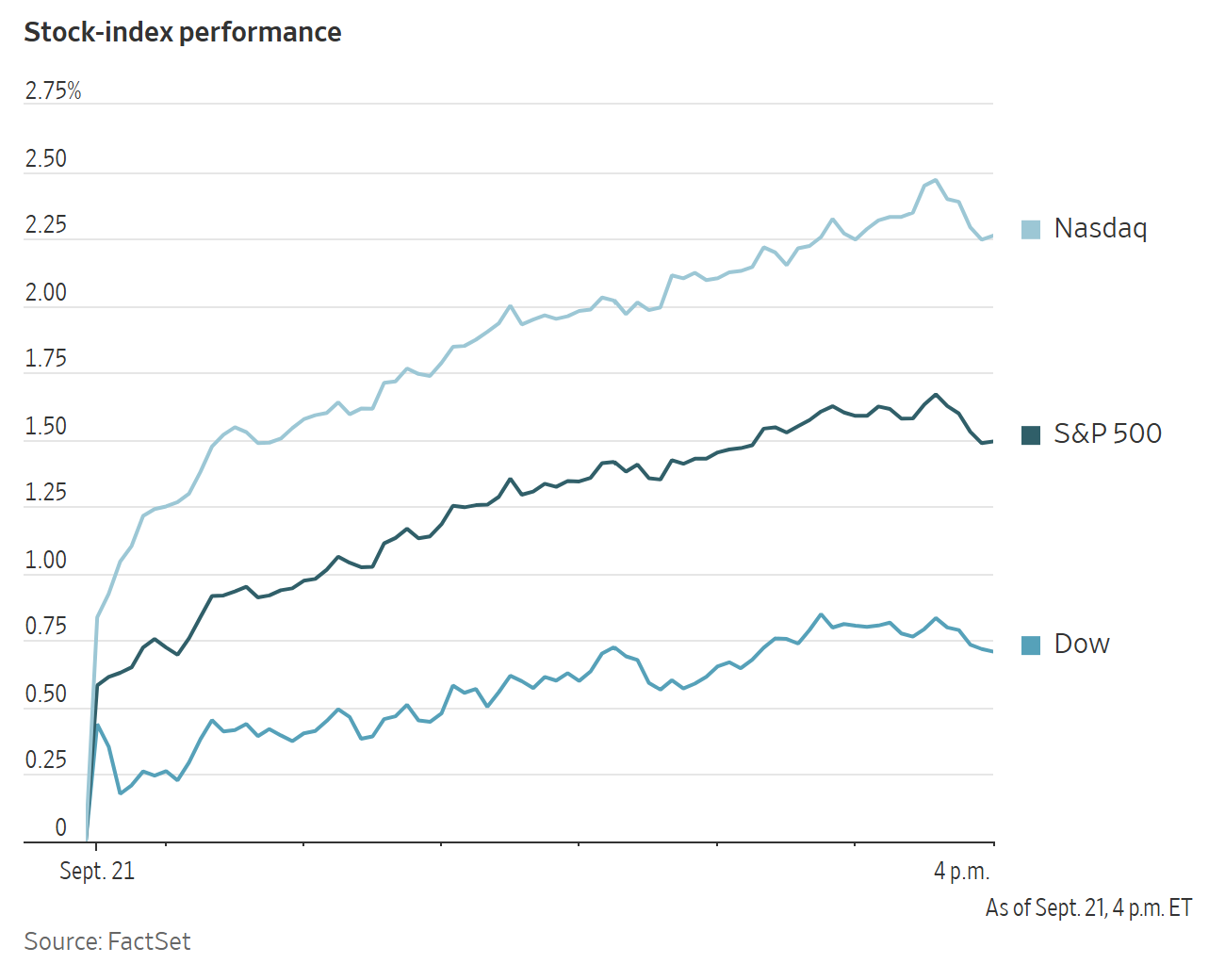
On Monday the Nasdaq Composite rose +2.26%, posting its third consecutive advance and closing at a record high. The S&P 500 gained +1.49%, while the Dow Jones Industrial Average advanced +0.71%, adding 366.19 points.
Market breadth was slightly positive, although the S&P 500 outperformed its equal-weighted counterpart by 0.94 percentage points.
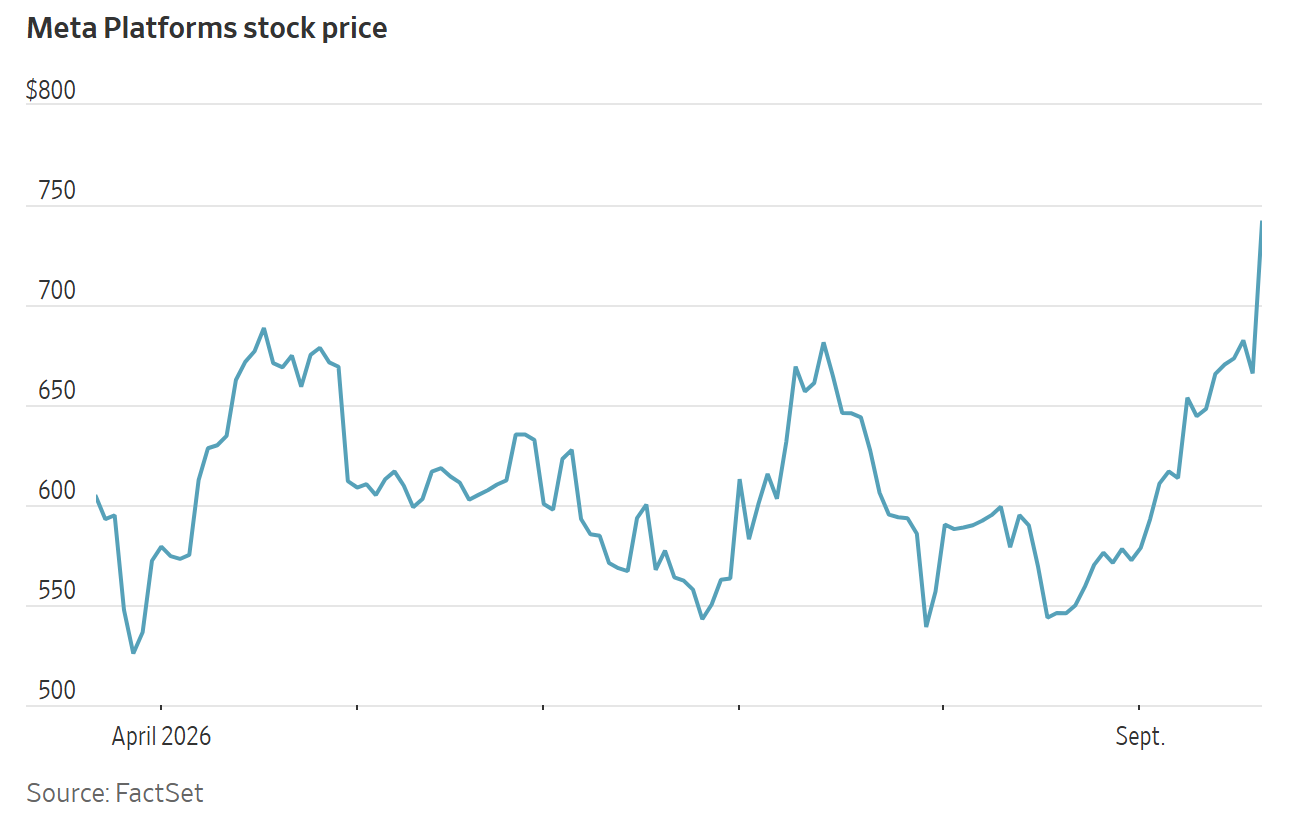
Meta Platforms had its best session in 17 months, supported by optimism around its AI agent, Muse, which reached the top spot in both the Apple App Store and Google Play. Analyst commentary on Muse was broadly positive, citing strong early engagement and potential monetisation opportunities tied to commerce.
Shopify shares also rallied after CEO Tobias Lütke said the company was partnering with Meta’s Muse to enable agentic checkout with Shop Pay across all Shopify stores. However, Amazon blocked Muse from accessing its platform, a move analysts said highlighted the potential threat to digital advertising businesses.
In corporate news, Paramount Skydance reached a settlement with the state’s attorney general, clearing the way for its contested merger with Warner Bros. Discovery.
The settlement, announced Monday, stopped short of requiring Paramount Chief Executive David Ellison to make significant structural changes to the company. Paramount committed to releasing at least 30 films per year for five years; failure to meet that threshold would require the company to divest its stake in Miramax and pay $30 million per missed film, with most of the proceeds directed toward supporting workers. If Paramount does not negotiate cable distribution for Warner and Paramount separately, it would also be required to divest a group of cable channels.
Separately, Bloomberg news reported that AMC Entertainment is seeking to raise nearly $4 billion of debt to overhaul much of its capital structure, using the box-office recovery to attract investors. The company has launched a $2 billion junk-bond offering and an $850 million leveraged-loan sale. It has also entered into a commitment letter with Deutsche Bank AG for a $1.12 billion second-lien loan.
European Stock Indices
CAC 40 +0.92%
DAX +1.07%
FTSE 100 +0.75%
Commodities
Gold spot -0.79% to $4,342.47 an ounce
Silver spot -0.34% to $66.01 an ounce
West Texas Intermediate -3.96% to $95.59 a barrel
Brent crude -3.07% to $100.07 a barrel
Gold prices declined on Monday as a firmer US dollar weighed on demand.
Spot gold fell -0.79% to $4,342.47 per ounce, after earlier dropping to an intraday low of $4,322.19 per ounce.
Spot silver eased -0.34% to $66.01 per ounce.
Oil prices softened on Monday to their lowest level in 12 days, as investors weighed prospects for diplomatic progress on the Iran conflict during this week’s UN meetings and monitored a partial recovery in Saudi crude shipments.
Brent crude futures for November settled at $100.07 per barrel, down $3.17, or -3.07%. The expiring WTI October contract fell $3.94, or -3.96%, to $95.59 per barrel, while the November contract stood at $92.47 per barrel.
Both benchmarks fell to their lowest levels since 9 September.
President Trump told Fox News that he would likely be open to meeting Iranian President Masoud Pezeshkian during this week’s UN General Assembly, while warning of further military action if the two sides do not reach an agreement soon.
Yemen’s Iran-backed Houthis said they had attacked Riyadh and a Saudi Aramco facility in the Red Sea city of Yanbu, while also seeking to cut off the Red Sea coast from remaining areas held by Saudi-backed forces.
Houthi attacks on Aramco’s East-West pipeline prompted the company to increase exports through the Strait of Hormuz this month and next after halting some shipments via Yanbu. Expectations for a partial recovery in Saudi shipments added further pressure to prices.
Reuters reported that Saudi Aramco loaded approximately 14 million barrels of crude oil onto seven supertankers in the Mideast Gulf on Sunday, according to tanker-tracking data. Satellite data showed Saudi oil flows through the Strait of Hormuz averaging 2.9 million bpd over the past six days, up from 700,000 bpd in August.
Bloomberg news reported that Russia plans to extend its ban on most diesel exports beyond the end of September amid continued Ukrainian attacks on domestic refineries. Separately, Reuters reported that Russia’s major Moscow refinery, owned by Gazprom Neft, halted crude oil processing after fires broke out at primary crude distillation units following a Ukrainian drone attack over the weekend.
The DOE said on Monday that strategic petroleum reserves for the week ended 18 September stood at 284.6 million barrels, down 0.4 million barrels w/o/w, marking the lowest level since October 1982.
Note: As of 4 pm EDT 21 September 2026
Currencies
EUR -0.19% to $1.1463
GBP -0.23% to $1.3362
Bitcoin +6.56% to $86,543.61
Ethereum +5.41% to $2,768.59
The Japanese yen retreated on Monday, its fifth decline in six sessions, as investors watched for any signs of potential currency intervention while the dollar strengthened broadly against its peers.
The yen weakened -0.25% against the greenback to ¥157.25 per dollar.
On Friday, following the BoJ rate decision, the yen fell sharply before recovering slightly after Nikkei reported that Japanese officials had conducted rate checks, a step often viewed as a precursor to currency intervention.
The dollar index rose +0.21% to 100.43, after gaining 1.13% last week, its largest weekly advance since early June.
The euro fell -0.19% to $1.1463 after the far-right Alternative for Germany won first place in state elections in northeastern Germany on Sunday. Chancellor Friedrich Merz’s Christian Democratic Union/Christian Social Union (CDU/CSU) suffered its worst regional election defeat in postwar Germany, leaving his government under pressure.
Sterling weakened -0.23% to $1.3362, remaining near seven-week lows.
UK data last week showed retail sales exceeded expectations in August, following figures released the prior week that indicated July growth had significantly outpaced forecasts. Money markets are pricing a 65% probability of a BoE rate hike in November.
Fixed Income
US 10-year Treasury -4.1 basis points to 4.956%
German 10-year Bund -6.6 basis points to 3.464%
UK 10-year Gilt -7.8 basis points to 5.219%
The US 10-year Treasury yield declined on Monday, while the two-year Treasury yield touched its highest level in more than two years.
The US 10-year Treasury yield was down -4.1 bps to 4.956%. Last week, the 10-year yield reached 5.041%, its highest level since 2007.
The two-year US Treasury yield ended the session up +0.1 bps at 4.753%, after earlier reaching 4.772%, its highest level since July 2024. At the long end of the curve, the 30-year yield was down -3.9 bps at 5.286%.
The US 2s10s yield curve bear-flattened on Monday, extending last week’s move. The spread stood at 20.3 bps, its flattest level since March 2025 and 4.2 bps narrower than Friday.
Traders saw a 55.4% probability of another 25 bps increase when the Fed meets in October, according to CME FedWatch. Money markets were pricing in 33.6 bps of additional monetary tightening for the rest of the year.
On Tuesday, the Treasury will auction $69 billion of two-year Treasury securities, with five- and seven-year auctions also scheduled this week.
Euro area bonds rebounded on Monday after Friday’s selloff.
The German 10-year Bund yield was down -6.6 bps at 3.464%. The two-year Schatz yield fell -8.3 bps to 3.210%, while the German 30-year yield declined -3.8 bps to 3.806%.
French and Italian government bond prices rebounded after Friday’s sell-off. France’s 10-year OAT yield was down -10.3 bps at 4.471%, while Italy’s 10-year BTP yield also fell -10.3 bps to 4.338%.
Money markets priced the ECB deposit rate at 3.00% by February and 3.36% by late 2027.
Note: As of 4 pm EDT 21 September 2026
While every effort has been made to verify the accuracy of this information, EXT Ltd. (hereafter known as “EXANTE”) cannot accept any responsibility or liability for reliance by any person on this publication or any of the information, opinions, or conclusions contained in this publication. The findings and views expressed in this publication do not necessarily reflect the views of EXANTE. Any action taken upon the information contained in this publication is strictly at your own risk. EXANTE will not be liable for any loss or damage in connection with this publication.
This article is provided to you for informational purposes only and should not be regarded as an offer or solicitation of an offer to buy or sell any investments or related services that may be referenced here. Trading financial instruments involves significant risk of loss and may not be suitable for all investors. Past performance is not a reliable indicator of future performance.






Created by professionals. For professionals.
